

A Food-Soaked Escape to Québec
Coming back from a weeklong trip through Québec, Canada, I realized I’ve been doing travel wrong. All this time I was under the impression I needed to spend hours on a flight overseas to experience a walkable city with culinary delights, stunning vistas and European charm. With a short flight to Québec, you can have all that and more.
Visiting Canada has been on my list for years. However, I’ve been overwhelmed by its size and possibilities. Do I go to Alberta? Its natural beauty has always captivated me. Catch a basketball game in Toronto? City life is a slam-dunk in my book. Or venture out to Vancouver, Ottawa, or Montreal? I simply did not know enough about those cities to have much of an opinion. In the end, I followed my stomach and landed on Québec after Michelin Guide announced their inaugural guide of the city was arriving in 2025.
I may have decided to visit Québec for the food, but the moment I stepped out of Québec City Airport and began the drive north to Charlevoix, I was enthralled by the region’s natural beauty. A steady mist hung over the lush landscape of enormous trees, rolling hills and mountains where a towering waterfall provided an occasional break in the scenery. I did not know how much I needed some quiet time with nature until I found myself staring out the window for the entire 90 minute drive to my hotel.
That first night I stayed at the Fairmont Le Manoir Richelieu. The property is perched high on the Pointe-au-Pic bluffs above the Saint Lawrence River with a restaurant that overlooks a bay where whales can be spotted.. Its castle-like architecture resembles a grand French manor and is nestled between the forest and the large body of water. It is a stunning backdrop for its iconic 27-hole golf course.
I wish I could have lingered longer at the quiet, riverside hotel but I had a jam-packed itinerary that would take me back the way I came and culminate in four days in Québec City.
The next morning the rain had let up but the skies were still cloudy. The drive from La Malbaie to Baie-Saint-Paul took us through Saint-Irénée, Les Éboulements and Isle-aux-Coudres with the river running by our side. With lots of open sky and plenty of greenery, I began to relax and recognize how taxing the frenetic pace of city life can be, as my shoulders started to drop.
Though only a short distance away, arriving at Le Germain on the gloomy day was a welcome reprieve. The one Michelin Key hotel and spa is built on what was once the largest wooden farm in Canada. It has kept its farmhouse roots alongside modern architecture. Fruits and vegetables harvested from the on-site organic garden are used on-site at the restaurant. Dozens of highland cows roam the property. And an outdoor Nordic-style spa overlooks the mountainside.
With its beautiful architecture, sleepy location and spectacular views, it is the kind of place Shane Hollander and Ilya Rozanov might jaunt off to for a romantic weekend.
I made a mental list to explore the region by train next time I visit. A train station connected to Québec City is located within the hotel’s property, making train travel an accessible alternative to experiencing the countryside by car.
By now it is probably obvious that I got distracted by the country’s natural beauty, but I came for the food. It was time to lock-in.
I am a sucker for eating at a hotel. There is no greater pleasure than ordering room service at a high-caliber location, but it was time to explore the local dining scene and Faux Bergers was my first stop.
The restaurant is located on a farm seated at the top of a rolling hill. It specializes in dishes made with seasonal, local ingredients. I was pleasantly surprised to walk-in to the cottage-style space and discover the 30ish-seat restaurant served all its diners at the same time. It provided a warm, convivial environment where each course was punctuated by the chef and sommelier explaining what was on our plates.
I made the mistake (or did I?) of taking lots of photos but losing myself to the moment and did not jot down the name and details of each dish I consumed. There are images of asparagus in a buttery creme sauce, crudo in a golden orange sauce and slivers of prosciutto. Their Instagram accounts provides more specifics. There is an oat and celeriac risotto made with a parsley purée and dressed with local cheese and mushrooms. A charred rutabaga is served with a smoked sturgeon sauce, kimchi, wild rice and gorria (the local red) pepper. It was the first meal in Canada where I could see how diverse their produce, and ways of preparing it with other ingredients, is.
It was a delight to find myself back there the next day doing a Famille Migneron de Charlevoix cheese tasting. The award-winning cheese company is a multi-generation, family-owned factory, winery and a distillery that repurposes its whey waste into boozy spirits.
Their signature cheese is the Le Migneron de Charlevoix, made from cow’s milk, the cheese is semi-soft with a delicate, buttery and fruity flavor. I could not get enough of Le Ciel de Charlevoix, a creamy and mellow blue-veined blue cheese. I found myself going back for my chunks of it, long after the tasting portion had ended. The flavors found at Famille Migneron de Charlevoix are the kind that inspires repeat visits.
Though not much of a drinker, I made a pitstop at Hydromel Charlevoix to learn more about this brand making wine and spirits from the region’s local honey, fruits and herbs. It is a cute, airy shop with walls of blonde wood shelves decked with glass bottles of the brand’s products.
The company also offers tours and tastings directly at its production site in Baie-Saint-Paul where you can taste refreshing and low-sweet honey wines as well as fine spirits, such as a gin and a honey liqueur. It is the perfect spot for wine and liquor connoisseurs.
Le Saint-Pub was my last stop before making my way back to the city. The brewery and restaurant is a local spot that offers hearty fare like poutine, lobster rolls and fish and chips. It is unfussy with a menu full of comfort food and a great spot to people watch.
But now it was time to leave the country. I am glad I took the time to rest and soak it all in because as soon as I stepped into Québec City, I wanted to see it all. I checked into Auberge Saint-Antoine, a charming hotel resembling a large European manor, sandwiched between buildings on a narrow street. The arched windows in my room overlooked a curtain(?)and the nearby buildings were so close, I felt I could reach out and touch them. After dropping off my bags, I headed out and made the climb to Château Frontenac, which overlooks the St. Lawrence River in old Québec. As I made my way through the streets I found myself amazed that I was only a two hour flight away from Chicago but walking through winding roads that resembled something straight out of Beauty and the Beast. I was dazzled and couldn’t get enough.
The days that followed included a visit to Cassis Monna & Filles, a family-owned, fifth-generation black currant producer on Île d’Orléans Quebec. The day-to-day operations are now in the hands of Catherine and Anne Monna. The sisters run the product line of award-winning liqueurs, wines, and gourmet food offerings. The estate sits on a grassy bluff with spectacular views of the river and features a small-scale production of goods in a workshop environment, a tasting room, a terrace restaurant, and a dairy bar known for its black currant soft serve. Picnic tables, adirondack chairs and table tops are scattered across the lawn, inviting all who visit to sit back and enjoy their purchases on-site.
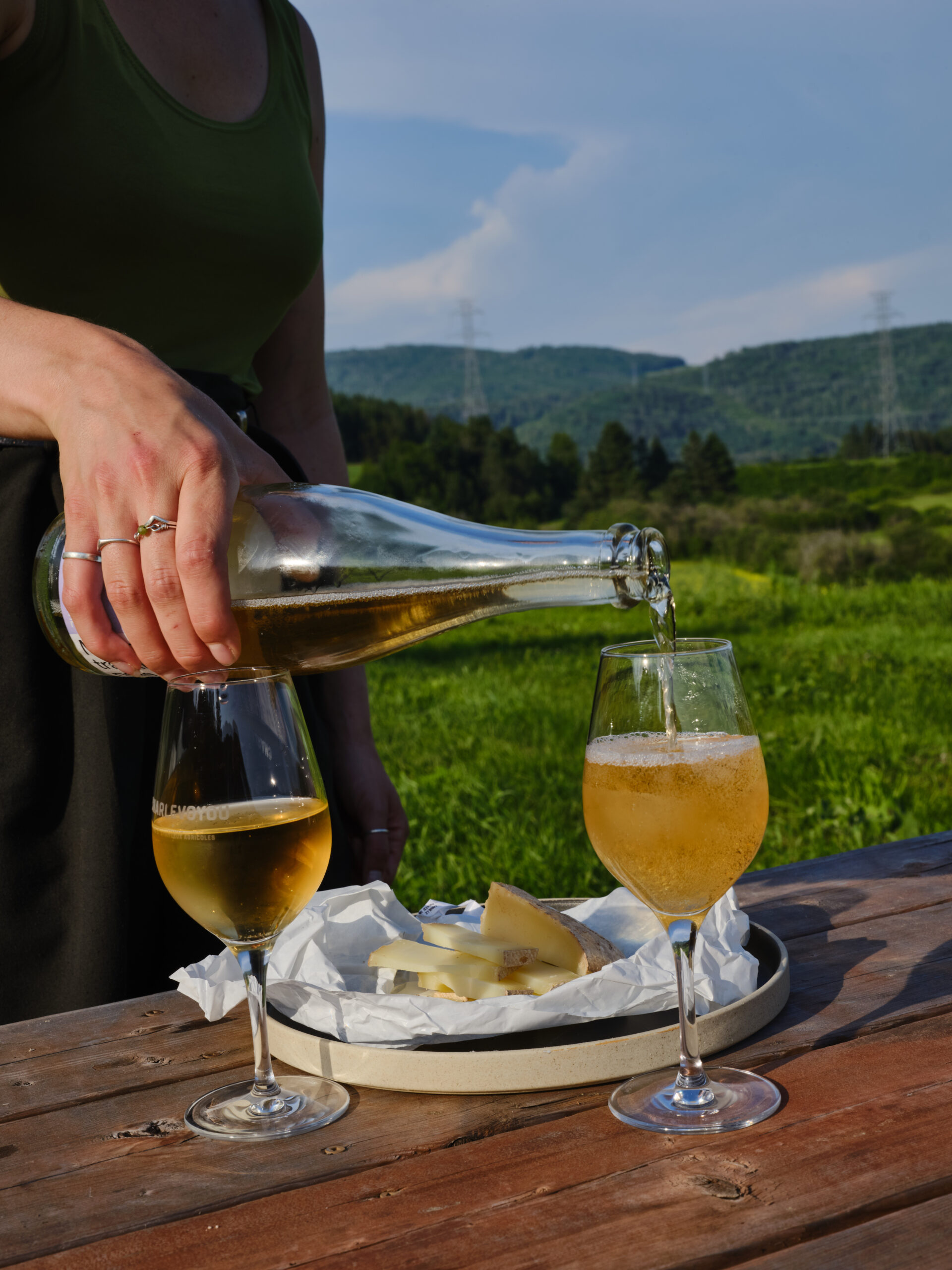
Dinner at Légende featured a menu where Chef Elliot Beaudoin only uses local ingredients (no citrus, avocado, peppers or chocolate on the menu). Indigenous ingredients are centered to make dishes like a homemade egg pasta, filled with savory pork and herbed potatoes, served in a velvety toasted hazelnut sauce with Alfred le Fermier, a local cheese that reflects Québec’s terroir, grated over the top. The restaurant was awarded a Michelin star days before my visit. Ferme Cidricole Équinoxe’s orchard was tranquil and gave a glimpse of what young food and beverage entrepreneurs are doing. It is the first cider farm in Québec and all their ciders are made from fruits grown in their own fields, spontaneously fermented with the farm’s wild flora found on their apples, with no artificial additives or added sulfites.
The stay at La Cecil House, a historical landmark and old mill, included dinner at Jean-Martin Fortier‘s Espace Old Mill, which is located on the ground floor. I dined on the back patio, watching the sunset and later ran into a solo traveler from Arizona who had come to taste Fortier’s philosophy first hand (one of three restaurants in Québec to receive a green Michelin star for their on-site gardening and sustainability practices).
I left Québec through Montreal overstuffed (and with bar recs from Fortier’s mixologist for my next visit!), wondering when I would be back and why it took me so long to get there.


