

Waste Not, Want Not: Closing the Waste Loop in Chicago
Chicago’s business community is getting into composting. But what does institutional growth look like when the best participants are volunteers?
Some of Chicago’s dirtiest trucks are actually pretty clean. Six days a week, you might spot a fleet of EVs roaming around, disappearing into alleyways, and collecting the city’s detritus. An assemblage of organic waste meets here in these vehicles—juiced limes, broken eggshells, old coffee grounds, used paper towels, your dead Trader Joe’s bouquet, a bowl of cereal gone soggy. Maybe even your cardboard carryout box of half-eaten chicken wings or that cold brew cup you grabbed on the way to the El. The contents of these trucks is a double dog dare just waiting to happen.
Sometimes when I picture a landfill, I imagine all that organic matter dissolving between layers of styrofoam cups and toothpaste tubes, disintegrating quickly enough to make more room for the new. Could be worse, right? In reality, when organic waste decomposes in a landfill without air, it produces methane, a greenhouse gas 28–80 times more potent than carbon dioxide. (Yikes, indeed.)
More than half of the 145 million tons of landfilled waste in the U.S. each year is organic. Over 20 years, our landfills emit 3.7 million metric tons of methane, “roughly equivalent to the annual emissions from driving 66 million gas-powered passenger cars or operating 79 coal-fired power plants,” according to RMI. (If you’re curious, 66 million vehicles is the same as about one in five gas-powered cars on the road.)
Luckily, composting drastically curbs these emissions, all while promoting a local, circular economy by turning organic matter into finished compost, a nutrient-rich fertilizer, and returning it to the community to grow more food and plants.
Earlier this spring, Sara Faddah, Dario Durham, and I spent a day following the folks at WasteNot Compost on their commercial service route to observe just a handful of the 400–500 pick-ups they do at restaurants, cafés, buildings, schools, and more each week.
Starting at WasteNot’s south garage, we met Tommy Vaughan, Growth Manager, Aria Frawley, Outreach and Education Manager, Matt Tiffin, Operations Manager, and Paige Hickman, Digital Media Specialist.
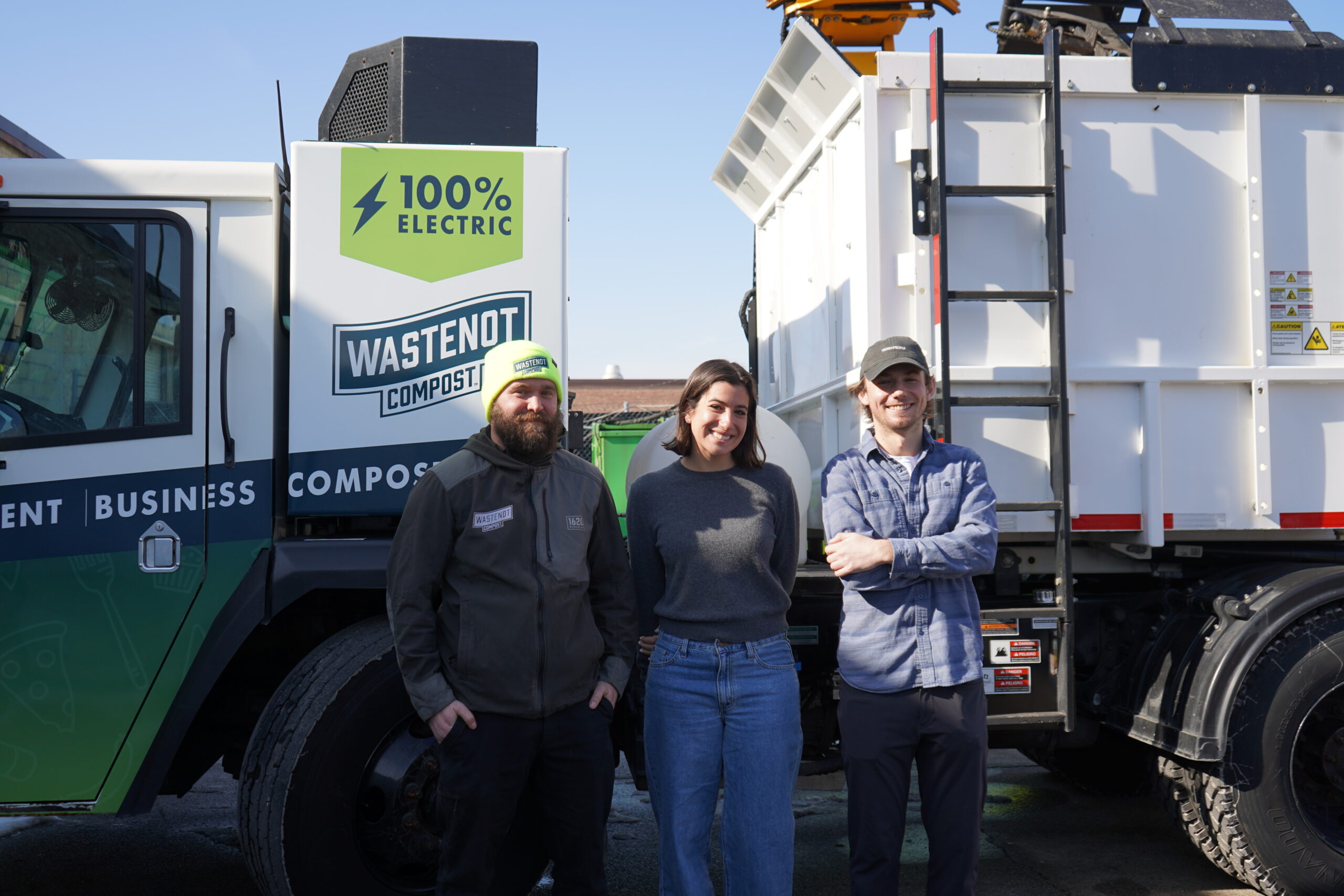
Wearing a hat embroidered with the words “trash person” on it, Vaughan showed us around their garage, equipped with a dozen or so EV charging stations, where they dispatch their collection vehicles for the day.
For the first few years in business, WasteNot’s co-founder and CEO Liam Donnelly handled pick-ups with a bike and trailer, until they transitioned to electric trucks in 2018 that could handle their growing volume. Using 100 percent EVs means while WasteNot’s team is hard at work collecting the city’s compost, they’re minimizing emissions even more.
From the garage, we made a pit stop at New Wave Coffee in Logan Square and met up with the manager, Jack Garland.
“For years, we had been doing to-go [orders] only due to the pandemic,” Garland noted, “So it was hard to see all of the cups, straws, lids, everything, just get trashed.” Noticing the opportunity, WasteNot approached New Wave and suggested they begin sourcing wholesale compostable products and composting with them. “The second we did it, we realized it was easy to have [all of our procurement] in one system,” Garland shared. A local chain, Dollop Coffee Co., owns New Wave and thirteen other cafés across the city, all of which have been procuring compostable serveware from and composting with WasteNot since 2022.
Down the street, we swung through the alley behind the blue line to service the bins behind Jeni’s Splendid Ice Cream. Their bins are mostly filled with used compostable cups, spoons, napkins, and the occasional cone. Unsurprisingly, most of Jeni’s customers are members of the clean bowl club, and not much melted ice cream makes its way into the bins. Five other Jeni’s locations in Chicago compost with WasteNot.
In addition to their 400–500 commercial clients, WasteNot services over 10,000 households, and in 2025, WasteNot diverted 6.4 million pounds of compost from the landfill. Notably, about half of that volume came from businesses, highlighting the impact of each institution that joins the program.
One thing keeping business participation at bay is cost. While individuals now have access to a free, city-run composting program—through Chicago’s Food Scrap Drop-Off Program launched in 2023—no such program exists for businesses.
The city’s program is limited to food scraps only (so no pizza boxes or compostable packaging) and requires individuals to travel to one of 33 drop-off sites, but it offers access to Chicagoans interested in composting who might not be willing or able to engage in a paid pick-up service like WasteNot’s. (Their residential pick-ups are $12 a pop.)
There has been some municipal support of commercial composting through the city’s Special Service Areas (SSAs), where property owners decide to provide additional services to benefit residents, merchants, and visitors funded by a dedicated, voluntary property tax. According to Vaughan, a few of Chicago’s SSAs in Wicker Park/Bucktown, Andersonville, Albany Park, and Lakeview have chosen to use this revenue to offer temporary funding, through total or partial subsidies, so that businesses in the SSA can start composting with WasteNot.
“It’s a way to introduce composting to these businesses in a relatively low-risk, low-cost way,” Vaughan noted. “And those programs have been really successful at getting people in the door. Once people get composting, it’s very rare that a chef or the staff want to stop doing it.”
The next stop on our ride-along: The Paramount Group (TPG), the hospitality group behind Paramount Events, eden, fuelgood, Cultivate, and Lake Street Staffing. Founder and CEO Jodi Fyfe says composting is central to their values—but it takes effort and intentionality to pull it off.
“It’s a lot less expensive to throw things in the garbage,” Fyfe remarked. “It’s also a lot easier from a kitchen or event [operations] standpoint. So, it’s a conscious effort and something that as a culture, we all agree to do, and we know the impact that it has.” Training, education, and employee engagement have been key to TPG’s success. TPG has a composting onboarding process for all new employees that covers what it is, how to do it, and why it’s important. They’ve set up their space to optimize flow and created signage including visuals as well as written instructions in English and Spanish.
“Was it perfect in the beginning? No. Did everybody understand? No,” Fyfe reflected. “Now it’s a no-brainer. It’s muscle memory.”
On January 1, 2025, a new Illinois law went into effect requiring large event venues with occupancies over 3,500 people to offer composting and recycling. (For context, capacity at a Bulls’ game is over 20,000.) If you’ve ever forlornly tossed an aluminum can into a trash bin at a concert, this is probably great news to you.
The law does not apply to outdoor festivals, street fairs, or smaller venues. It’s much more limited in scope compared to California’s 2022 statewide mandatory organic waste collection mandate, which requires all residents and businesses to compost unless specifically excepted.
Legislative action can be an attractive way to build on the community’s existing successes, create or expand infrastructure, lift barriers, and take impactful practices like composting mainstream. California is aiming to reduce organic waste in landfills by 75 percent.
To get there, the state is building 20 new industrial composting facilities (adding to their existing 200). Grist reported that “cities, towns, and other jurisdictions with access to residential food and yard waste collection jumped from 50 percent to nearly 80 percent” between 2022 and 2024.
It can also have unintended consequences. “In California, you see a lot of contamination,” noted Vaughan, referring to non-organic materials that end up in compost facilities, including conventional plastics like bags, wrappers, and cutlery, as well as glass, metal, produce stickers, and even diapers.
“To do composting at scale, you need to think upstream,” Vaughan remarked. “What are these things that could end up in the compost that shouldn’t be, and how do we get ahead of that with procurement?”
“Here in Illinois, we have people doing this out of their own volition. They’re paying for it. They’re not doing it because they have to, and we have a much cleaner stream. Our restaurant owners and businesses that we work with really care about making sure that the material they give us is actually going to be turned into compost.”
Another incidental effect of California’s composting mandate has been sidelining local composters. 2024 reporting from Grist found that after the mandate took place, small composting businesses started losing customers in droves after the city signed contacts with large waste companies that bundled their compost, recycling, and trash pick-up services, and many customers couldn’t afford to or didn’t see a reason to pay for two services.
So if far-reaching mandates can create contamination and tank local businesses, how else can Chicago structurally support composting’s growth and maximize its impacts at scale? Education, engagement, and time, it seems. “If the business owner doesn’t have buy-in, it’s not going to work,” Fyfe commented.
WasteNot’s Outreach and Education Manager Aria Frawley works with several school districts in the county, teaching students about composting in the classroom before they introduce it in the cafeteria.
“When the schools are composting with us, it makes it a lot easier for people to do it properly at home,” said Frawley.
“I think people underestimate how impactful kids can be when it comes to environmentalism and sustainability. If you have students who are doing this every day and are invested in it, they will go home and tell their parents. I’ve had so many kids drag their parent up to me at the farmers market and say to them, ‘We’re doing this.’”


