

The Roots of Food Policy with Chicago Food Policy Action Council
Food is political. From what’s served in your kid’s school cafeteria to which crops receive federal subsidies, policy decisions shape every bite we take, often without us realizing it. That’s why we’re excited to announce an ongoing partnership with the Chicago Food Policy Action Council (CFPAC) for a recurring food policy column in each issue of Edible Chicago.
CFPAC has spent more than two decades working to make Chicago’s food system healthier, equitable, and more transparent. In this column, they’ll help us decode the complex, often invisible world of food policy: what it is, how it works, and why it matters to everyday eaters.
Whether you’re a seasoned advocate or someone who’s simply curious about where your food comes from, our goal is to make this world accessible and actionable. And if you feel inspired to get involved, there’s a place for everyone in this work.
We’re kicking things off with a conversation about the basics: what food policy is and how CFPAC goes about shaping it. Grateful to Rodger Cooley, Executive Director of the Chicago Food Policy Action Council (CFPAC), for jumping in here with us!
Rodger has worked for 25+ years in urban agriculture and sustainable equitable food systems helping facilitate policy, projects, and network development.
Rodger serves on the Cook County Commission on Social Innovation, the Chicago Food Equity Council, the Illinois Agriculture Equity Commission, and the National Sustainable Agriculture Coalition’s Organizational Council.
(MM) So, what exactly is the Chicago Food Policy Action Council?
(RC) I have been fortunate to work on building a more healthy, fair, humane, sustainable, and just food system for over 25 years now.
Over that time I’ve come to see food policy as the rules, laws, practices, budgets, taxes, incentives, and purchases made by local, state, and federal government that determine: what food we eat; how that food is grown, harvested, shipped, processed, packaged, prepared, and sold to us; who does that work, the conditions they work under, and how they are paid; how safe is the food when it comes to us; the environmental impacts of how the food is grown; how food waste is composted, rescued, reused, or put in landfills; who can afford farmland and will be remain farmland; and what is even considered healthy food!
I find it really hard to not find an example of how policy in one way or another impacts the foods I eat. This can make food policy seem overwhelming, complex, and hard to change. But at the same time, everyone eats and wants food to bring joy, health, and celebration to their lives—making food a motivating issue to advocate for!
(MM) Let’s start with the basics. How would you define food policy?
(RC) The Chicago Food Policy Action Council (CFPAC) works to move our food system to be healthy, fair, humane, sustainable, and just with many partners who touch the food system in some way: communities, farmers, organizations, businesses, institutions, funders, government, food banks and pantries, wholesalers, processors, farmers markets, advocates, among many others.
Systems level change work has to involve so many partners because to address the underlying causes beyond short term and temporary fixes, it requires getting as many of the actors in the system to collaborate together. And for people (who make up any organization) to collaborate they need to feel welcomed, listened to, and trust the other people in the room. So, a lot of our time and energy is spent hosting spaces (virtual and in person) where the wide diversity of partners are welcomed, connect with each other, share information and resources, and ways to work together.
A great example of our work is our annual Chicago Food Justice Summit that takes place each March. We just held our 21st Summit (free to attend!) with two virtual days followed by an in-person event, a keynote speaker and over 25 sessions with local, regional, and event national presenters and attendees. We have over 1,400 people participate across the 3 days.
(MM) How does food policy impact the average Chicagoan?
(RC) Institutional food procurement is one of the more direct connections for most Chicagoans and folks in the region. This includes food purchased and served at or by government run and owned spaces including schools, hospitals, senior meals, jails, higher education, conference centers, sporting venues, parks, airports, and other spaces.
There are policies that help determine what food is bought and served, as well as if the institution itself or an outside company will be preparing the meals (i.e., Food Service Management Companies /FSMCs). Since the late 1990s, there has been a growing movement locally and nationally to get local food into these institutions. Farm to School was one of the earliest ones, asking: “We have farmers in our communities, and we want healthier food in our schools — why is it so hard to get this to work?”
Procurement policies over time prioritized lowest prices as the core value. Lots of advocacy work has been done since 2000 to shift procurement laws and rules to open the door for local farmers. Building on the focus on local farmers, other advocates saw an opportunity to include other values in procurement policy — environmental sustainability, humane treatment of livestock, fair and safe conditions for food system workers, and improved nutrition standards.
Enter the Good Food Purchasing Policy.
(RC) The Los Angeles Food Policy Council pulled these values together as the Good Food Purchasing Policy (GFPP) in the early 2010s and successfully implemented the policy with the LA Unified School District.
Building on the success in LA, CFPAC with a coalition of 30+ local partners in 2015 collectively advocated for the GFPP to be adopted in Chicago during the 2015 Mayoral Runoff election between Mayor Rahm Emanuel and now Congressman Jesus “Chewy” Garcia. Both campaigns signed off on the idea.
The coalitions worked with Mayor Emanuel’s administration to understand the GFPP standards and how to implement them. By 2017, Chicago Public Schools, Chicago Park District, and Chicago City Council all adopted the policy. Cook County Commissioner Garcia (at the time) worked with CFPAC and its partners to get the county to adopt GFPP in 2018, shifting procurement at the County hospital, jail, and juvenile detention center. Chicago and Cook County were early adopters and the first outside of California.
In 2026, there are now over 60 institutions across the country implementing GFPP, impacting over 450 million meals served annually. A gathering of local and national partners, Power of Procurement PoP26, was held at the South Shore Cultural Center in October 2025. We were excited to share the progress we’ve made in the Chicago area and learn from the great work elsewhere.
(MM) The work continues.
(RC) CFPAC, in partnership with the IL Food Justice Alliance, continue advocacy efforts to get the State of Illinois to adopt GFPP for its institutions. We are a member of the National Sustainable Agriculture Coalition, supporting bills at Congress to shift federal agency food procurement toward GFPP focused values.
We are very appreciative of the partnership we have with Chicago and Cook County to move the work forward.
There are many dedicated staff in each agency who work in complicated systems with many regulations and budgetary limits. They are committed to getting the best food possible to the communities they feed while supporting local farmers in the Chicago region. But it requires the political leaders who set policy goals and their budgets give them the resources and permission to make the vision of a just food system real.
(MM) How can readers get involved?
(RC) To get our political leaders to care, local voters need to reach out to Chicago Aldermen, the Mayor, Cook County Commissioners and President, IL legislators and the Governor, plus our US Representatives and Senators. Let our elected officials know that a local, sustainable, fair, humane, healthy, and just food system is what we want in Chicago and Illinois.
There are several organizations readers can connect with to stay up-to-date with active and upcoming policy actions. These organizations collaborate to build collective power with each other, their members, and all of our supporters together.
Chicago Food Policy Action Council (CFPAC)
Sign up for the CFPAC newsletter, follow us on social media, and for more active engagement join our Rhizome network google group to get regular emails, bi-weekly policy call notices, and other gatherings. (chicagofoodpolicy.com)
Illinois Stewardship Alliance (ISA)
Connect with ISA to get updates on sustainable agriculture policy efforts at IL and federal levels. They are a 50 year old alliance of sustainable farmers and eaters! (ilstewards.org)
Illinois Environmental Council (IEC)
IEC is a membership coalition with over 130 organizations advocating for a diversity of sustainability issues including food and agriculture. They have a very strong presence in Springfield and are actively engaged in Chicago as well. (ilenviro.org)
National Sustainable Agriculture Coalition (NSAC)
NSAC and its 150+ members (including CFPAC, ISA, and IEC) from across the US advocate for federal programs, funds, regulations, and practices that support local, sustainable, and socially disadvantaged farmers. Sign up for newsletters and follow along on social media to keep up to date on action alerts. (sustainableagriculture.net)
Only through engaged and active eaters who become advocates and voters will we be able to meaningfully shift policy toward the food system we want and deserve.
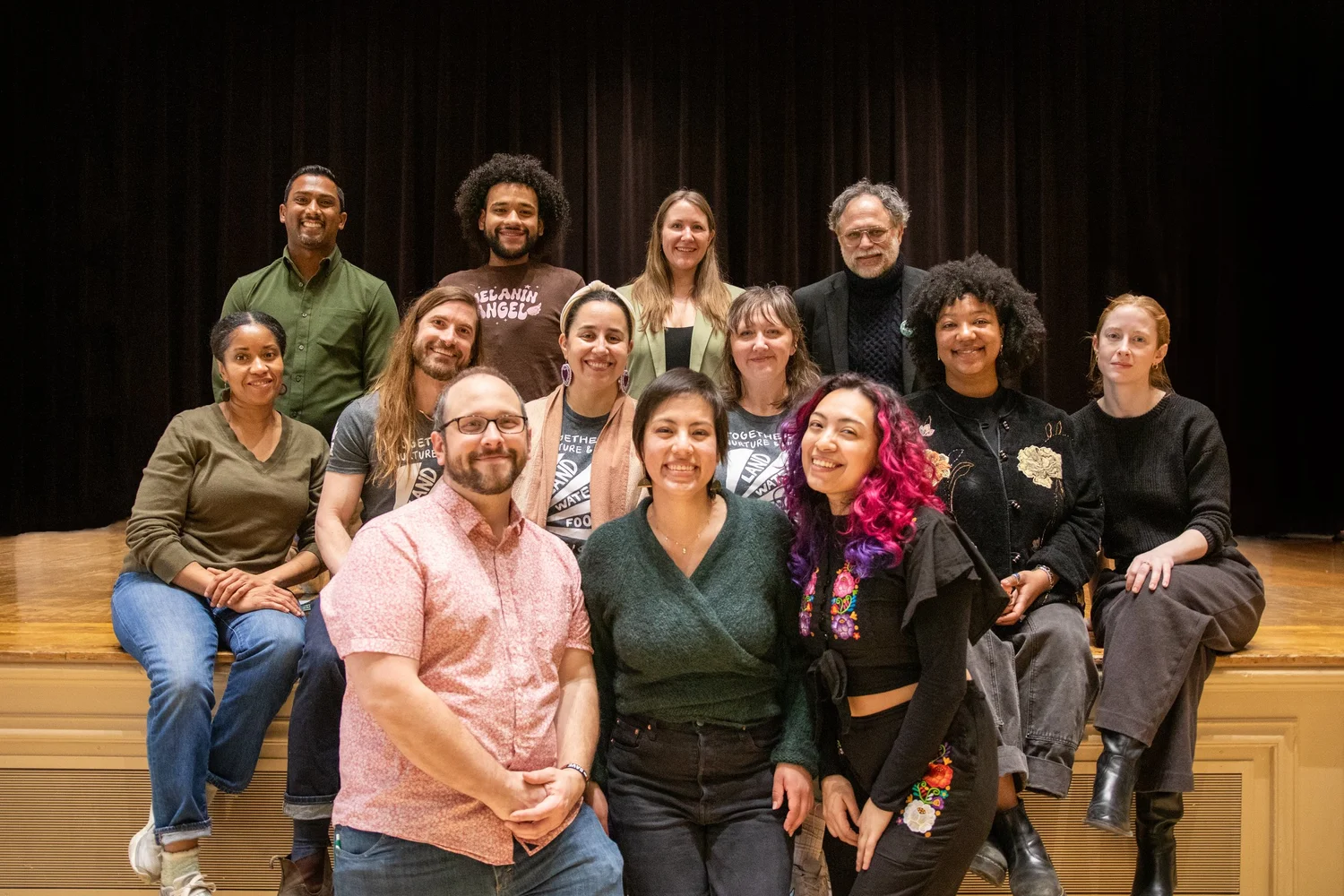
Photo by Nate Hansen – The CFPAC team at the 2026 Food Justice Summit.


