

Down at the Farms
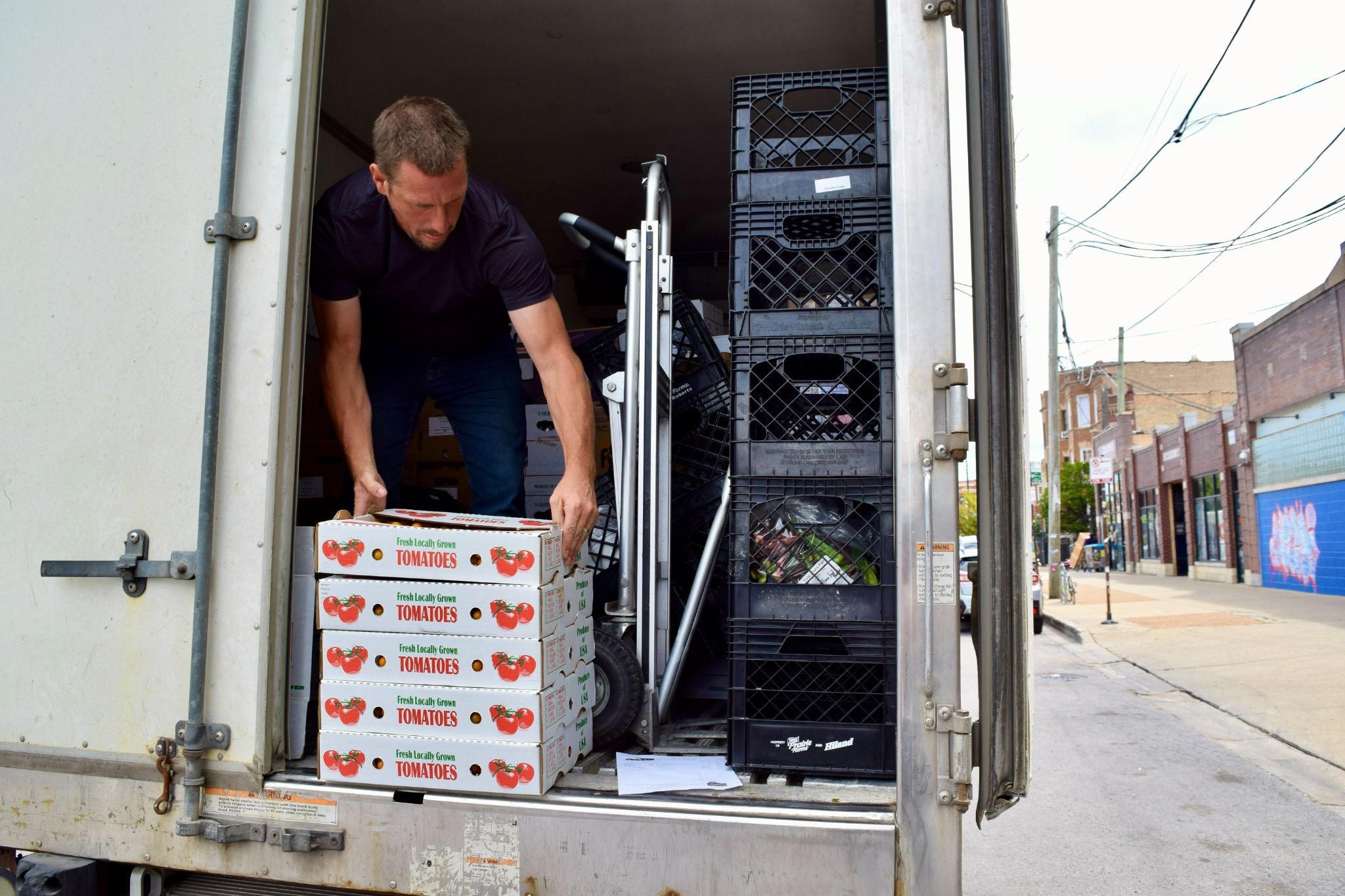
On a Wednesday morning in the West Loop, Swadesi Cafe on Jefferson Street is full of Chicagoans getting their pre-work fix. The sounds of the city are in full blast – construction across the street, trains going by, cars honking, and one unassuming white truck pulling up to Swadesi’s entrance. Three hours prior, the truck was loaded with hundreds of pounds of food at the Down at the Farms warehouse in Central Illinois. Now, it’ll deliver the milk that makes Swadesi’s coffee menu so special, followed by many of the ingredients you’ll eat at your dinner reservation tonight.
Tim Roth, farmer and delivery driver, hands an invoice to the manager at Swadesi after a brief chat and heads out the door. Don’t worry, we’re hitching a ride.
Down at the Farms is a farmer-to-farmer marketing and delivery service based outside Fairbury, Illinois, and owned by Marty and Will Travis. Every week, restaurants, grocers, markets, and kitchens fill out a spreadsheet to place their order. The spreadsheet contains hundreds of rows, including the name of each farm, each product they’re currently offering, and the price. Buyers simply note their name and desired quantity next to each product they want to purchase. Meat, dairy, vegetables, fruits, grains, honey, herbs, and eggs all in one place. A digital farm-to-table marketplace.
“[Down at the Farms is] really one of the first of its kind,” Tim shares. “Probably one of the best in the country.” The goal has always been farmer-first, and cultivating relationships with chefs has aided in farmer support. Selling with Down at the Farms gives growers confidence knowing they have access to a stable market. Moreover, Marty has acted as a mentor, teaching farmers how to grow nutritious food by maximizing biodiversity rather than chemical inputs. Marty conducts field visits and in-person interviews with all farms new to the service to, as Tim puts it, “make sure they are actually growing food in the way we want to sell it.”
“In many cases, [Down at the Farms] is an incubator for small farms,” says Tim, explaining that dealing with ‘the middleman’ often results in higher processing costs and less profit directed back to farmers. Down at the Farms ensures small farms can still thrive, despite the increasing pressure of consolidation and industrialization. Tim shares that when he was starting up his own farm, Living Light Farms, Marty helped make things worthwhile. “Everyone wants to buy chicken breast, but what do I do with the rest of the chicken?” Thankfully, Marty knew a chicken-back-buyer.
Normally, there are three delivery routes but this day, a driver was out. That meant Tim and Jace, the other driver, are both taking on more than normal. Jace will start the day dropping off two pallets – 2-3,000 pounds – of local flour to Publican Quality Bread. Then, he’ll deliver chicken, bone broth, and collagen to Nourished, an organic market store in Hinsdale. Downtown, Jace will stop by a number of restaurants: Frontera Grill, Smyth, The Loyalist, Boka, Ox Bar & Hearth, Feld, Nettare, and more.
Tim will stay mostly within city limits before heading to a few stops in the northern and northwestern suburbs.We’ll see Laimoon, The Radicle, Cellar Door Provisions, Daisies, Lula Cafe, Bungalow by Middle Brow, Anelya, TriBecca’s, Superkhana, Wild Onion Market, and more.
Being down by a driver means a change in route for the both of them, which could cause logistical challenges. “You kind of have to know the city a little bit,” Tim says, clearly as an understatement. He’s been driving since 2021. “We try to not change up the routes too often, because there are relationships there.” Seeing the same workers week after week is a highlight of these deliveries, and it’s not just the chefs and sous chefs. “Even building relationships with the security officers and dock workers smooths things out,” says Tim.
These relationships are sustained even when a chef moves on to another restaurant. There have been multiple instances where a chef will move to a new restaurant, and that restaurant will start buying from Down at the Farms. Evanton’s Burl, for example, has three chefs that Tim has known across multiple restaurants. A handful of chefs have even paid a visit to Tim’s farm, either to see the land or share a meal – or both.
At each stop, the process is largely the same. The invoice has handwritten notes on how many boxes, flats, bags, and/or crates each order has been packed into. We walk through alleyways, down a flight of stairs, and into dungeon-like kitchens – many of which are blasting Bad Bunny. “We often joke that you have to have hiring requirements on height to work in this kitchen,” Tim says about Daisies and their low ceilings.
Someone comes to check the order and make sure everything’s there. Occasionally, a restaurant will have set aside empty cardboard produce boxes for Tim to take – a prized possession in the food distribution world. We learn that the abundance of peppers ordered by The Radicle will be used for their supreme pizza , as well as for research and development for new summer dishes. At Lula Cafe, evening prep leads Bella and Jen walk through their order invoice. “Anise hyssop is very seasonal. It’s a short, fleeting season,” Jen explains. “So right now we use the anise in our salsa verde, which is used in the sea bream dish.”
“Sungolds are used in our tomato salad at night,” Bella says. “The base is a tomato puree, and then there’s an oregano vinaigrette with fresh heirlooms and sungolds.”
They point out the uses of the mandarins, onions, and buttermilk before suggesting an impromptu herb taste test of the anise hyssop and purslane. We all chime in with the ways we’ve seen purslane used: Jen as a salad mix and Tim as a ‘living mulch’ for farmers who practice low-till.
Back in the truck, Tim revels in these moments. “As a farmer, it’s really nice to meet the people who are actually using the food,” he says. “It’s a lot more satisfying and worthwhile to put in the work and know that there’s a face behind it.” When he receives feedback from chefs, Tim makes sure to get the message back to whichever farmer supplied the restaurant.
As 3 p.m. passes us by, logistical challenges arise. How will Tim get to Elawa Farm in Lake Forest by their closing time at 4 p.m.? What about Iron and Acre in Deerfield, who were told to expect a delivery at 3:30 p.m.? After a handful of back-and-forth calls, Tim has made his plan. Despite being five blocks from Burl in Evanston, we head straight for Lake Forest. Burl can wait, others cannot. He’ll hit Elawa, Iron and Acre, then embark on the journey to All Grass Farms in Dundee, before swinging back to Burl on his way back south.
“Probably won’t be back in Evanston until around 7 or 8 p.m.,” says Tim. A night this late means Tim likely won’t be back home until 11 p.m.
It’s a whole day away from his own farm, which is a sacrifice. Between deliveries, Tim shares a handful of challenges he’s facing at Living Light, from leasing land to market affordability. He raises grass-fed beef and pastured poultry and pork, all of which require an enormous workload that falls to him and his family rather than hired help. Yet, he offers his Wednesdays to make the city’s farm-to-table scene go ‘round. Seemingly, it’s the relationships that keep him coming back. It’s catching up with Becca at TriBecca’s, Meghan at The Radicle, Sam and Kathryn at Elawa Farm. It’s asking the security officer at the Old Post Office building how his wife is doing, and hoping we run into Terrence at the loading dock.
This web of relationships, of labor, of coordination, is what allows a dinner to start with a farm’s name and a sense of place instead of an anonymous ingredient. It’s thanks to Tim, Jace, Chance, Marty, Will, and everyone behind Down at the Farms that farmers in Central Illinois are supported; that chefs are sourcing sustainably produced ingredients; and that Chicago eaters have full bellies.


