

A Truffle’s Journey From Alba to Logan Square, with Love
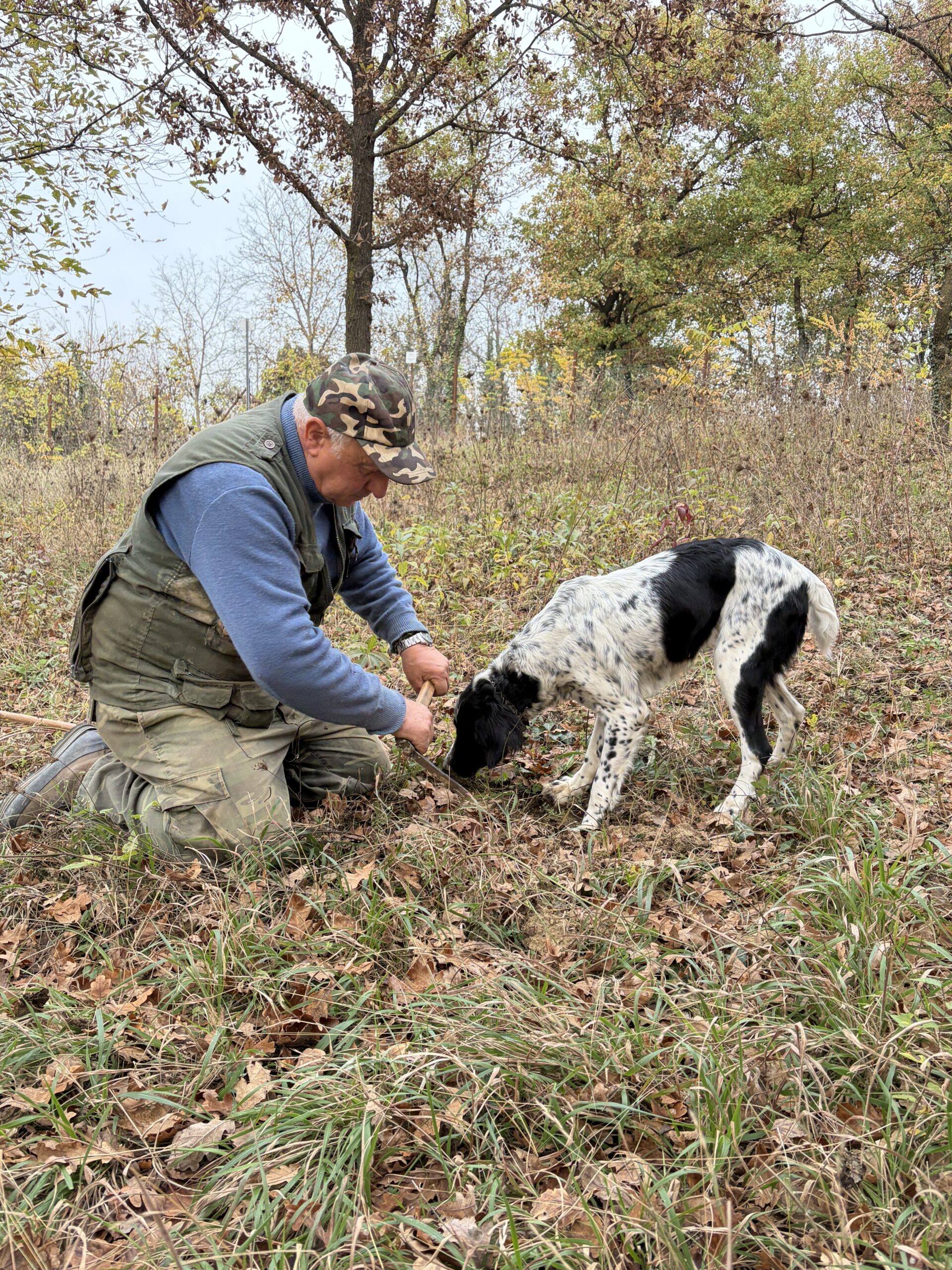
It’s dawn in the woods outside Alba, in Piemonte’s Langhe hills – Italy’s truffle epicenter. Blue‑gray light filters through poplars; the air is cold enough to sting the inside of my nose. I’m walking just behind Michele, a sixty‑something truffle hunter who has spent his entire life reading this forest the way other people read newspapers. His gait is steady, unhurried, shaped by decades of predawn mornings just like this one. Beside him trots Macchia –that’s Spot in inglese—his speckled, barrel‑chested mutt with a nose that sniffs the forest floor with purpose.
Fog clings low to the ground, softening the outlines of oak roots and fallen branches. The leaves under our boots are damp, fragrant, releasing that unmistakable Langhe perfume: wet earth, bruised chestnuts, crushed acorns, woodsmoke from a farmhouse chimney hidden somewhere in the folds of the hills. The only real sound is Macchia’s paws brushing through the undergrowth, his tail held in a quiver of anticipation. Every few steps he pauses, nose twitching, drawing in information I’ll never be able to perceive as a mere human.
I came to Piemonte chasing a scent – one I’d tasted in Chicago, shaved over fresh egg fettuccine, folded into risotto, but never truly understood how it arrived on my plate.
Macchia lowers his head, circles a patch of soil, and freezes.
Michele stops instantly. He reads the dog’s body like a familiar dialect.
“I trust Macchia’s nose completely,” he said. “He can smell the gas a truffle releases underground. It’s a smell so faint a human would never notice it. But to him it’s like a flare.”
Michele begins to carefully dig with a curved spade, as if unwrapping something fragile, a gift from the forest floor.
When the truffle finally emerges, still warm from the earth, it feels like a small miracle. In that moment, with the fog lifting and the scent rising, the journey of this truffle, from this patch of woods to a plate half a world away begins.
From bosco to Boeing
By midmorning, the quiet woods had given way to Alba’s buzzing truffle market. The piazza is a swirl of brokers, chefs, tourists, and locals, all orbiting tables piled with the morning’s finds. Espresso mingles with the unmistakable musk of truffle.
Here, truffles move through hands with a choreography unchanged for generations: hunter → broker → grader → exporter. Prices rise and fall by the hour, and the process runs on trust.
“Trust is fundamental in any commercial relationship, but in the truffle trade it is absolutely essential,” said Veronica Giraudo, Export Manager at Tartuflanghe, one of Italy’s leading exporters of the prized Tuber magnatum Pico, also known as Alba white truffle. Her family has been in the business for decades, and she speaks about truffles the way some people speak about family heirlooms.
She nods toward Michele, who had just arrived with the morning’s finds.
“Hunters like Michele are the backbone of what we do,” she said. “He brings us beautiful truffles, always fresh, always honest. When he walks in, I know the day will be good. A healthy supply chain is built on relationships that are honest, transparent, and long‑lasting,” Veronica added.
Once sold, the truffle’s life becomes a raging race against decay.
In Tartuflanghe’s facility, workers brush away soil from the precious white truffle with the tenderness of someone cleaning a newborn.
“The shelf life of a truffle is only 10–15 days once it’s out of the ground,” said Veronica. “To ensure quality, the stages from harvesting to shipping must be compressed into just a few hours.”
The best specimens are tagged with QR codes linking to videos of the exact truffle ground where they were harvested. Then they’re wrapped in paper towels, nestled into chilled polystyrene containers, and sealed with ice packs.
Timing is everything.
Truffles are collected in the wee hours of the morning, cleaned by late morning, packed by afternoon, and out the door by 5 p.m. They reach Chicago’s O’Hare Airport within 24 hours.
Sending them off never gets old. “It is always electrifying,” said Veronica. “We’re sending a piece of our terroir, our history, our culture.”
Somewhere over the Atlantic, the truffle flies through the night, preparing for its next act.
From Alba to Logan Square, with love
In Chicago’s Logan Square, Aldo Zaninotti of Osteria Langhe knows exactly when to expect the knock. “We start to get truffles the third week of October,” he told me. “Sometimes the season extends to mid‑January. The height is November.” By then, his in‑the‑know diners have already started calling, asking the same hopeful question every year: Are they here yet?
“Our truffle dealer personally escorts the truffles directly here, from O’Hare,” he said, “And the ritual is almost sacred. He lays a cloth on the table, sets down a scale, and unwraps each truffle one by one.”
The truffle’s final act begins tableside. “We bring a tray with a dome and one single, beautiful truffle on display,” Zaninotti said. “I take the dome off and let our customers smell it first. It’s quite an experience. Then I start shaving.”
The shavings fall like delicate petals onto dishes intentionally simple: tajarin with butter, risotto with Fontina, agnolotti del plin with fonduta. Two grams per serving is standard.
Zaninotti pairs the earthy, heady perfume of shaved truffles with wines that elevate rather than overshadow, leaning on Piedmont’s small, meticulous producers who understand exactly how to frame their aroma. “People come from near and far to celebrate truffle season here,” he said. “Especially the Italians in Chicago who miss home. One bite and it’s as if they’re back in Piemonte.”
From the misty forests of Alba, to the muddy paws of a mutt, to a chef’s steady hands, to an osteria table in Logan Square. I can’t help but to think of the earthy, pungent truffle aroma rising from a plate in Chicago and how it mirrors the fog lifting over the Langhe hills; the same scent, the same story, carried across oceans. A love letter written in a fragrance that’s sharp, musky, unmistakably of the earth, answered an ocean away.


