
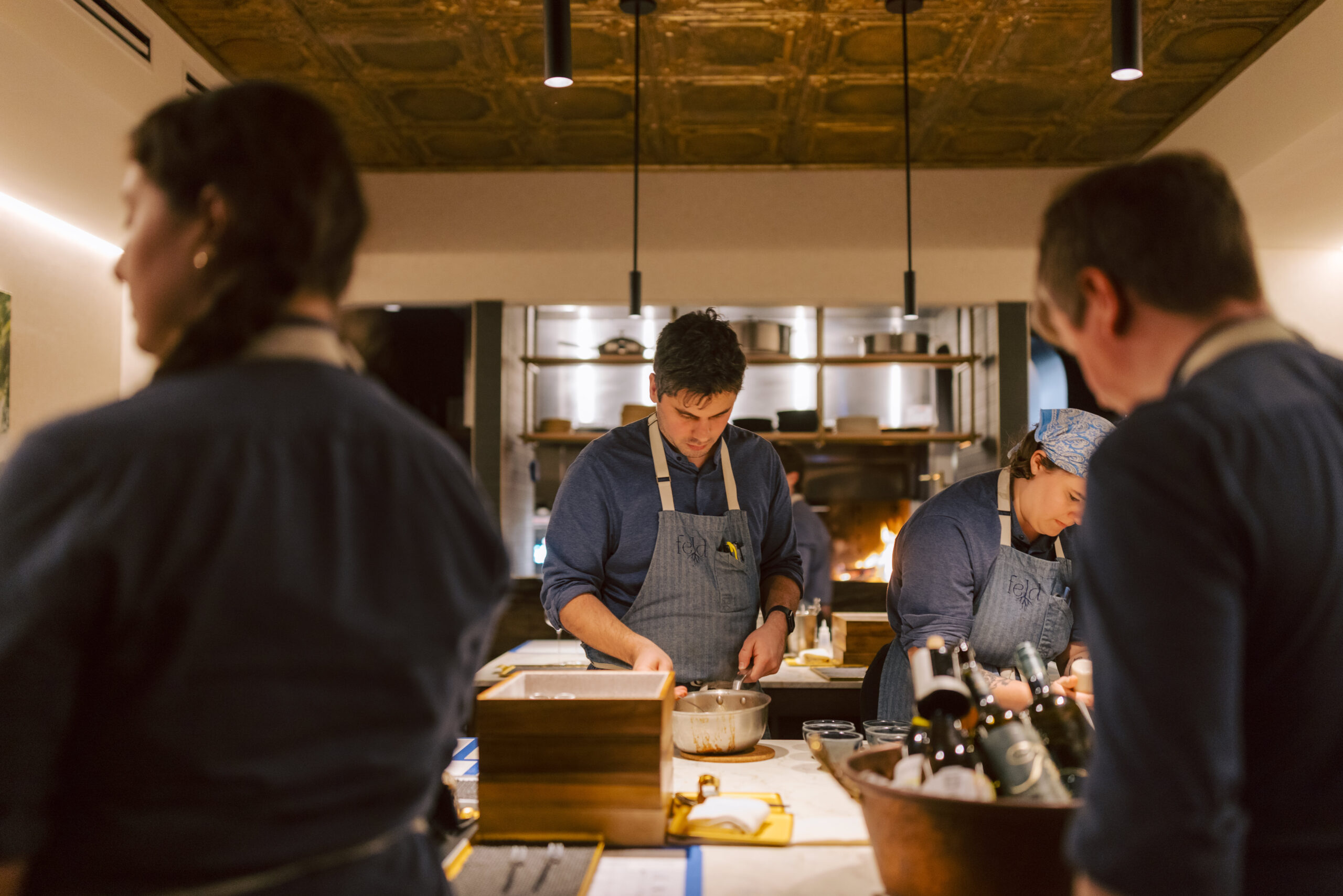

At the Table with Feld
Feld is a small, 20-seat restaurant in Ukrainian Village that built its reputation on a simple but demanding premise: cook with what small farmers can realistically produce, not what a traditional restaurant menu demands. Led by chef-owner Jake Potashnick, Feld moves at the pace of its growers—shifting dishes daily, adapting to scarcity, and building relationships that dictate what ends up on the plate. It’s a values-driven model — part experiment, part act of devotion — and it turned Feld into a subject of fascination long before anyone tasted a bite.
As Feld’s opening story went viral on social media, I was stepping into my own new project. I had just taken the reins of Edible Chicago — a publication rooted in the same questions Feld seemed to be asking. What would it look like to build something that reflects the food system we want, not the one we’ve inherited? What if farmers and producers were more than a menu footnote?
I didn’t know Feld’s chef-owner Jake Potashnick yet, but I recognized the values. I wanted to see how this restaurant planned to deliver on the vision racking up followers from around the world.
The first glimpse came at a preopening pop-up: five guests crowded around the kitchen island in Jake’s apartment, with his partner, Sophie, assisting with service. One guest’s fine-dining fluency caught my attention; it would take months to realize she was the Beth Lang — the elusive, anxiety-inducing Chicago diner later immortalized on Apple TV’s Knives Edge.
Here I understood that the vision for the restaurant wasn’t focused solely on proximity in the traditional “farm-to-table” sense. Jake was focused on sustainable growing practices, small producers, and direct relationships.
You still see it on the menus today. “Sue’s Scallops” aren’t some improbable Lake Michigan surprise — thankfully — but seasonal imports sourced directly from Sue Buxton’s day-boat operation in Deer Isle, Maine.
I left the apartment that evening with a sense of trepidation. Feld was bold and earnest and fragile in the way all new ideas are. I wanted it to succeed because, selfishly, it felt like proof that people cared about sourcing, about farmers, about the stories behind food. Maybe they’d even read the magazine.
A year later — just hours after the Edible Chicago relaunch party — I joined Jake and one of Feld’s earliest hires, Miguel Huerta, for a visit to Kilgus Farmstead in Fairbury, Illinois.


We talked about market work, menu development, and the cookbooks shaping their vision — Quay, especially. I wanted to understand the principles beyond “relationship to table.” Two ideas stuck with me: “a mix of Japanese hospitality and Nordic flavors,” and a creative approach that leaned “more improvisation than sketch comedy.” Miguel absorbed everything — technique, sourcing logic, hospitality traditions — as he prepared for opening.
Feld, at that moment, was balancing on the edge of possibility. Resumes were arriving from around the country. Cooks were relocating to Chicago for the chance to be part of the opening team. Permits were still in process. A few key ingredients still needed sourcing. Dairy was one of them, which is how we ended up among the Jersey cows at Kilgus — a farm whose products still appear regularly on Feld’s menus today.
Then came summer 2024. Feld’s books opened and I made my reservation for about three weeks into service. I dined at the precipice of the opening fall out. I’d seen the online vitriol brewing but avoided deep dives; I wanted my own experience.
Dinner was theatrical, fast-paced, and — at its best — inspiring. The zucchini. The corn panna cotta. The infamous three-day cheese plate. But there were bumps: a wobbling table, frantic pacing, a couple of dishes that simply didn’t land. And in the context of the online discourse, I left holding my breath.
Two days later, a brutal Substack review on The Hunger dropped, referring to a meal at Feld as “the worst meal in 19 years of criticism.”
When I saw Jake at Green City Market afterward, the interaction felt like running into a friend after a loss. He looked visibly gutted. I’d genuinely enjoyed most of my meal, and I believed in the potential. But I’d be lying if I said I wasn’t worried — they needed time to find their footing, and I wasn’t sure they’d get it.


I made my second reservation for late January.
If opening in the context of summer’s abundant produce was challenging, what would a seasonal menu in January look like?
But Feld was turning a corner.
The menu had tightened from 30-plus bites to 24.
The room was calmer.
My table stayed steady.
The team — remarkably — was still nearly intact, less one opening team member.
The green tea panna cotta, made with tea sourced from Annie Xiang of Volition Tea, was delicate and exacting.
Nathan Ducker, Feld’s effervescent General Manager and Sommelier, recommended a nonalcoholic pour of Muri’s Passing Clouds. I’ve regularly referred sober and sober curious people to this bottle since.
Their sourcing advantage was clearer now too.
With only about 20-40 guests a night, they can buy from producers whose volumes would be impossible for larger restaurants. The commitment isn’t easier — it’s just more feasible at their scale.
Because of that scale, Feld sits in a rare pocket of the dining ecosystem. Many Chicago chefs deeply value local producers, but their volume needs simply outpace what specialty farms can provide — especially those operating on a handful of acres, raising heritage animals in limited quantities, or harvesting micro-seasonal crops only when the weather cooperates. A restaurant serving 150 covers a night can’t build an entire menu around a single farmer’s cabbage crop or a cheesemaker’s one-off experiment.
Feld can.
Their constraints become creative parameters — menus shifting daily based on whatever arrives at the back door, in quantities small enough to be precious. It’s not a more virtuous approach so much as a structurally different one: the smaller the dining room, the less you need to depend on wholesale distribution and the closer you can get to the farm.
They don’t need truckloads, just enough of the good stuff to honor both the grower and the ingredient. In a season defined by roots, storage crops, and preserved flavors, the constraints felt like clarity rather than hardship.
My most recent visit was the second Cooks Will Play dinner — a night without Jake. Looser, more playful, a chance for the cooks to experiment with dishes that might not be “Feld enough” under normal circumstances.
Four cooks, four bites of picanha — a friendly internal showdown. A foie panisse that instantly became one of my favorite Feld dishes. And then came the drop. A flamboyant reversal of the multi-bite course that frequently begins the meal, this time in the form of dessert.
That evening proved that Feld had already evolved beyond Jake. It’s a living system — shaped by collaboration, improvisation, and trust. There is a palpable enthusiasm from the entire team at Feld, and after such a tumultuous opening, I believe the shared vision is paramount to their resiliency.
Watching Feld evolve clarified something I’ve been learning while rebuilding Edible Chicago: values matter, but values without flexibility become dogma.
Restaurants — like any business — are built by people trying, failing, adjusting, recommitting, and occasionally cracking open an Old Style out back.
Ideals need structure but they also need air.
Just 24 hours before we went to print, Feld earned its first Michelin star and joined Daisies as one of Chicago’s only Michelin green star recipients.
In some part — it feels like a lightning strike of success for a first-time restaurant owner to be awarded a star just 16 months into service. On the other hand, well-earned recognition after the recalibration, the criticism, the adjustments, the very human evolution.
Here’s hoping Feld’s recognition opens the door a little wider for every restaurant brave enough to put producers first.


