
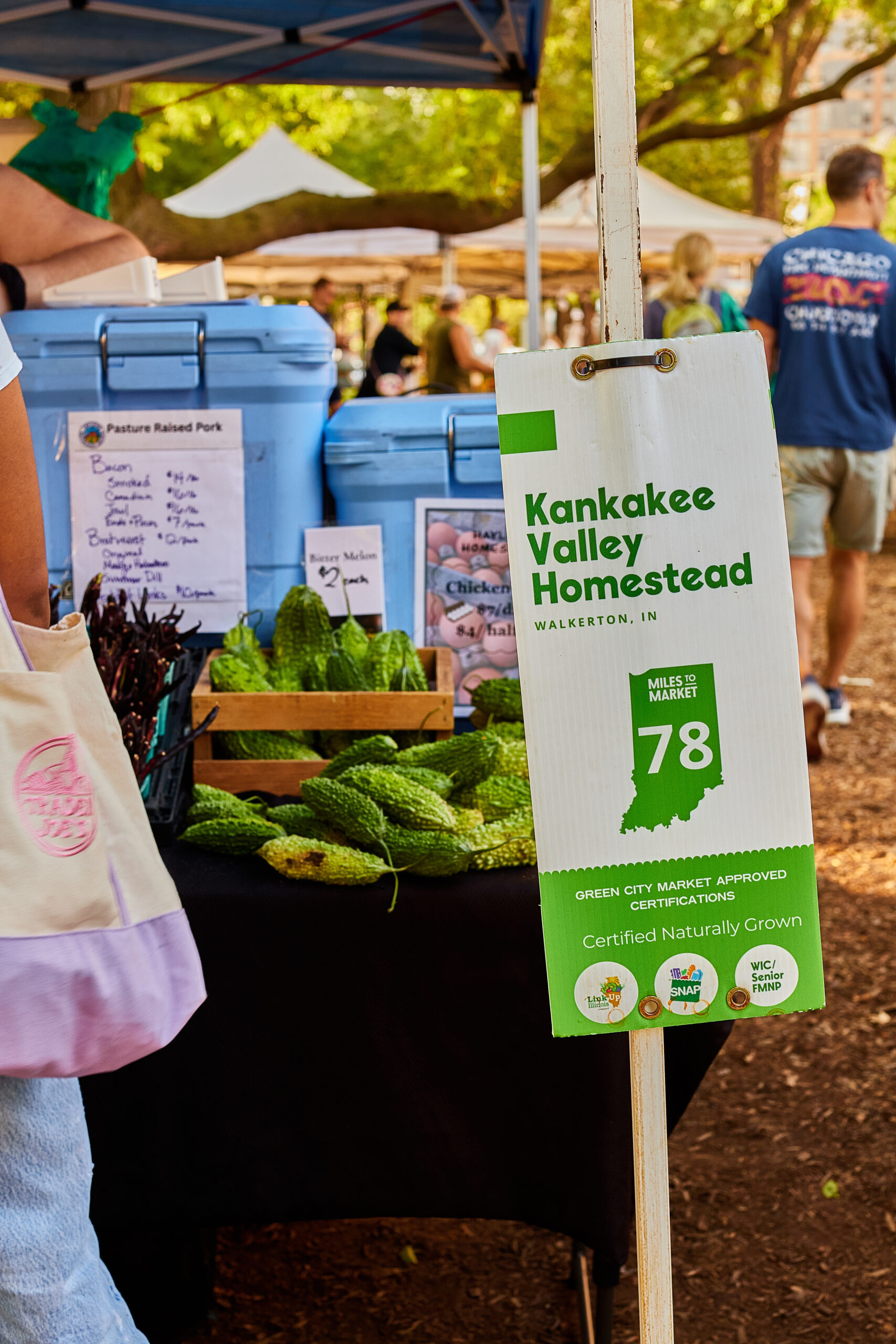

Kankakee Valley Homestead Relocates as Hayloft Homestead
Before Tom Eich started Kankakee Valley Homestead, he worked as a teacher, frequently in schools with many low-income and food-insecure students. He saw firsthand how hunger can impact a student’s success, so he tried to help. He would bring food into his classrooms, until one day he got in trouble. Since he “couldn’t feed everybody” in the school, the principal argued he shouldn’t be allowed to feed anybody.
Like any person with the traits of a successful farmer – determination, grit, perseverance – he set out to prove this wrong. He started Kankakee Valley to try to feed everybody. “It obviously wasn’t realistic for one person, but that doesn’t mean I can’t try,” says Tom.
Nearly a decade after founding Kankakee Valley, that mission is entering a new chapter. This year, the farm is being reborn as Hayloft Homestead. The land in Walkerton, Indiana where Kankakee Valley leased land is currently under dispute with a solar company. As the company considers the option of purchasing the farmland, Kankakee Valley can no longer lease the property. Concurrently, Tom, alongside his partner Abby, found the opportunity to start a new farm in Kouts, Indiana where Hayloft will stand. Since January, Tom and Abby have been renovating buildings, turning the pasture into vegetable fields, and moving their animals to Hayloft.
A transition like this one points to change, uncertainty, and excitement. At the new site, Tom and Abby are looking forward to serving a more niche market. “Our goal for Hayloft, since we have a lot less land here,” says Tom, “is to grow a unique variety of vegetables.” While they had to give up their cattle, they’re hoping to find a stable market for their Mangalitsa pigs. They are one of few farms in Indiana that are home to the fluffy, Hungarian breed. Hayloft still has chickens, and will still be growing corn for their crowd-pleasing popcorn, which is popped fresh at markets and offered through their Popcorn Club CSA. “I’m hoping eventually we can also start selling some baked goods, since we’re planting fruit,” Abby shares.
Their planting decisions are heavily shaped by the relationships they’ve established with chefs due to their presence at Green City Market. Tom notes that they’ve done a lot of wild foraging, and “a lot of that knowledge came from the chefs, when they come out to the farm and show us these ingredients that we now bring to the market.”
For instance, pineapple weed is a wild chamomile that is native to the area and pops up in early spring. It has a tropical-like flavor, but it wasn’t until Jake Potashnick of Feld came out to the farm that Tom had ever noticed the plant before. “Now, it’s one of our top-selling items every spring, and we spend a lot of time harvesting it, and people use it to make teas, gelato, and kombucha,” he shares.
Beyond these chef partnerships, the farm’s commitment to food access and food justice has certainly stuck. Abby, before joining Tom at the farm, worked the SNAP booth at the Bloomington and Michigan City farmers’ markets. With both of their backgrounds in food access, they’ve made some magic happen. “We founded one of the first triple match programs of its kind in Indiana,” says Tom. It’s modeled after the Green City Market program, which multiplies the purchasing power of federal food assistance benefits, as a way to increase access to buying local, fresh produce. During the first year of the program, Tom and Abby self-funded it through an $800 donation before passing it on to community funding.
This same ethos of community accountability carries over into Tom and Abby’s farming approach. The farm is Certified Naturally Grown, which follows the same standards as organic, but was formed from a grassroots movement where the farmers are the inspectors. “We pay our dues to the organization rather than fees to the government,” says Tom. “It really helps build a community because we are inspecting each other.”
Sustainability comes easily to Tom and Abby, and this shows up in more ways than just the certification. In addition to using all natural inputs, they rely on their livestock to fertilize the fields where they plant their vegetables. “They’re out in the vegetable fields in the winter, and then in the summer, we move them into the pasture,” he says. “I actually have not in nine years of farming applied one fertilizer.” Even more shocking, Tom has never irrigated his fields, meaning their water footprint is extremely marginal. “We just hope for rain.” As Hayloft Homestead takes root in Kouts, that same hope in nature is what’s carrying them forward.
Visit Hayloft Homestead at these market locations:
Wednesdays at Green City Lincoln Park, 7am-1pm
Saturdays at Green City West Loop, 8am-1pm and Green City Lincoln Park, 7am-1pm
Sundays at Logan Square Farmers Market, 8:30AM – 3PM
Stay up-to-date on farm happenings on social media.


