

Dion’s Chicago Dream: From Unhoused Veteran to Tackling Food Insecurity
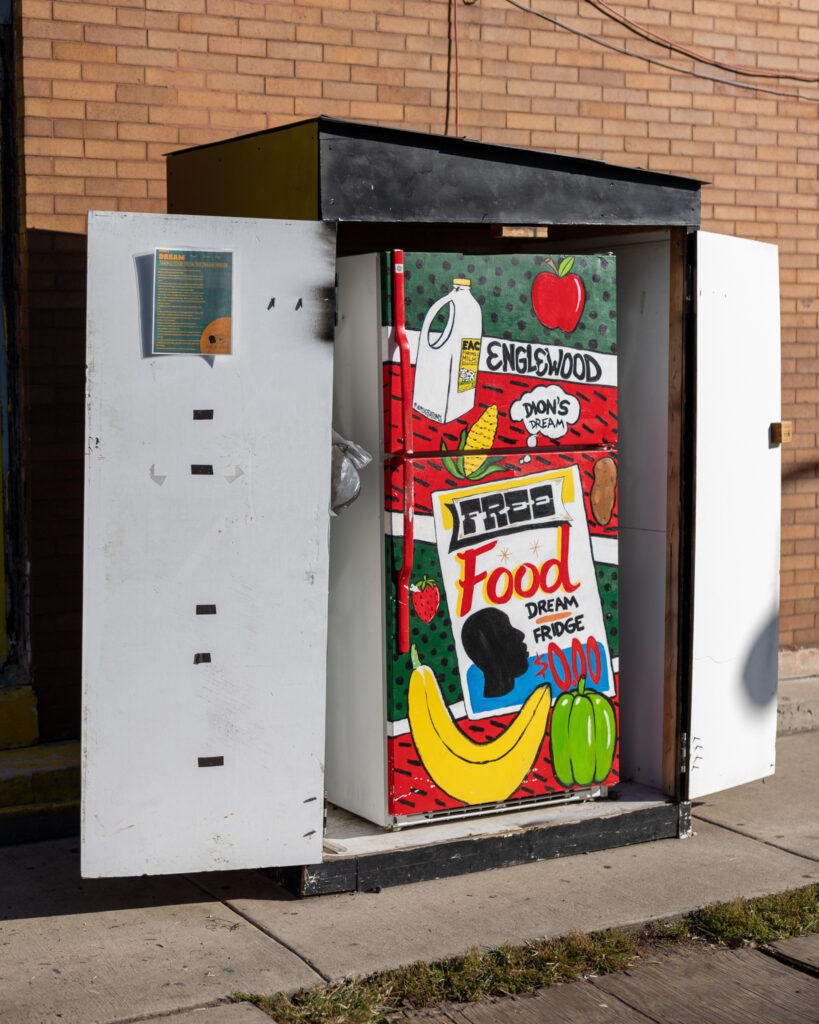
When we first met Dion, the founder of Dion’s Chicago Dream, he had just finished setting up his non-profit. It was two years ago at one of our favorite pizza shops, Vito and Nick’s. We had just sat down and were reviewing questions when he walked in and introduced himself. We had seen some of his work through social media and were familiar with the Dream Fridge in Englewood, a public refrigerator that he would fill with fresh produce for the neighborhood. What we didn’t know was that Dion was a veteran himself who once experienced food insecurity and homelessness, and was now packing boxes of fresh produce into his trunk to deliver to people in need. Flash forward to today – Dion’s Chicago Dream is approaching a new milestone. We reconnected with Dion to hear more about the organization’s impact.
Sara: Do you remember what we were talking about two years ago? You didn’t own a building, or a fleet of trucks; no employees, either. You were packing food in your trunk and making deliveries. Dion’s Chicago Dream was a single person operation. Where are you today?
Dion: Today? Let’s see, 65,000 pounds [of fresh produce] per month delivered to 1,200 households in 45 Chicagoland neighborhoods and 8 suburbs per week, all free of charge. We employ 26 individuals, own 7 delivery trucks, and a warehouse. We just bought a location that’s going to open in June that’s 20,000 square feet; it’s called DreamVille Campus. And as of the end of 2023, we’re a $4 million organization.
Dario: Two years ago, you showed us your bank account and you had $17.
Dion: How wild is that? It feels good but I’m not surprised. I really feel like anything is possible, right? It takes a lot to get to that point, and I don’t even think it was all good. I really think it’s a combination of lived experiences and trauma. Everyone that is not in our circle tries to convince us to be a realist, and it gets us nowhere.
Sara: You started with just a run to the grocery store for fresh produce, then you packed up the boxes in the back of your car and delivered the food yourself. Tell us more about how you started. Who are the people that are food insecure? Because we know it’s not always homelessness that leads to food insecurity.
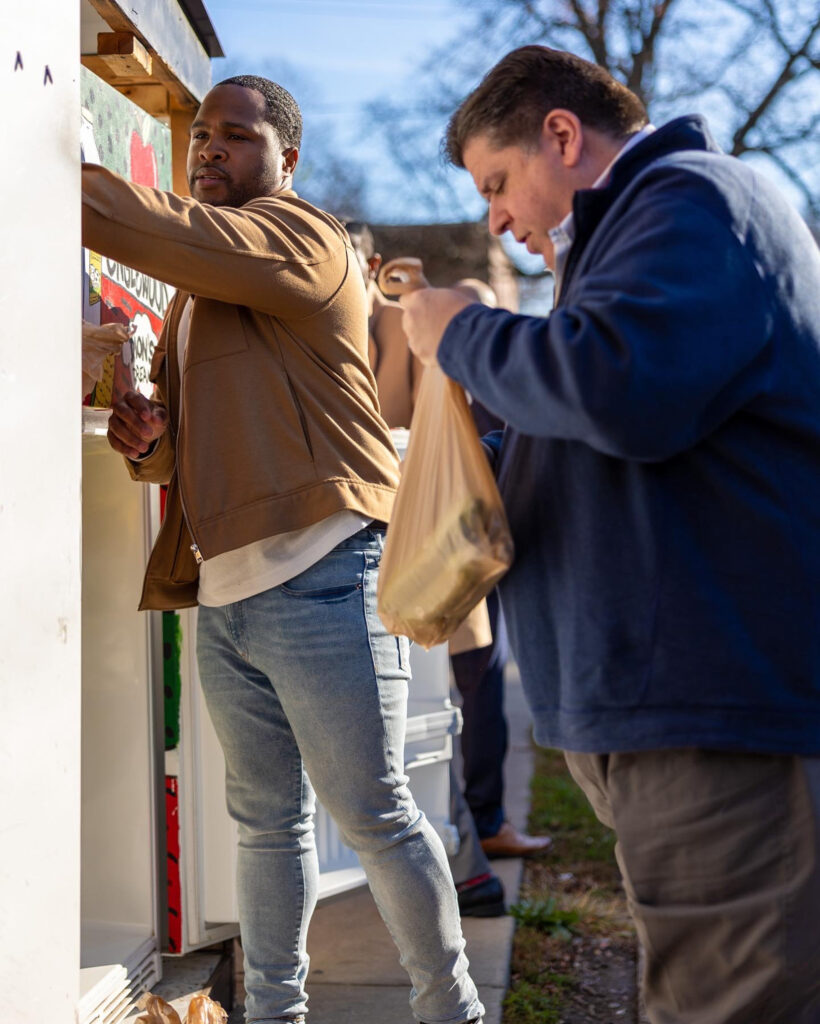
Dion: There’s never really a steady profile on who is food insecure. There’s no middle class right now; …it’s people in condos, who own homes, with roommates, in shelters and living outside. It’s not a demographic. You might not have a steady job or you might have a job, but you live in a neighborhood that doesn’t have a grocery store–or there’s a grocery store but no fresh produce.
Dario: You always say you just need a name, address, phone number and number of individuals in a household; no salary info [to request your team’s services.]. You’ve also mentioned that the type of food included in each box is important.
Dion: Grapes is an example, or pomegranate; I had never had either. We could’ve easily left those out of the box because they have a higher price point but…we’re indirectly showing people what they deserve. A lot of credit goes to J.A.B Produce who has been with us every step of the way, they give us some good produce.
Dario: You went through a time where you were houseless and food insecure. How much of that experience led to the work you do today?
Dion: When I look back at my time before and after the military, which was six years, there was nothing I experienced longer than homelessness and food insecurity; most of my life was spent not knowing where my next meal would come from. I came back to Chicago to make Chicago better or at least give something back to it. I don’t remember all my military experience, but I do remember the first time I was on a flight deck in the middle of the night and saw nothing and I freaked out; the thought of Chicago calmed me down.
Sara: You’re from Englewood and you’ve said you experienced that when people think of food insecurity, they tend to think of the south side of Chicago. That part of the city does face food apartheid. But what played a part in picking Englewood and what has changed over the last four years?
Dion: I picked Englewood because I was born and raised there, and I feel like I owe a debt to Englewood that I still haven’t paid back. As a veteran, if I was a failure, it would have been because of Englewood, and if I was a success, it would have been because of the military. A lot of people talk about what neighborhoods like Englewood and Austin and Garfield Park and North Lawndale need, but they don’t invest; they don’t move to them to learn what the community actually needs.
The thing about the grocery industry is it’s extremely expensive to run a grocery store. Razor thin profit margins and so most grocery stores that survive are attached to generational wealth. No grocery store wants to build out a store and then it does not work. They want it to survive. And when it does not, it costs them a lot of money. We [at Dion’s Chicago Dream] spent millions on food and created a model that is direct to consumer and as a result, we didn’t have to wait multiple years or do years of fundraising – only to hope for a shot. As a result, we’ve been able to build and grow.
Sara: I remember last time we spoke I asked you what your 5 year plan was, and you said you hate that question.
Dion: Yes, and I still don’t have [an answer]. Things change. I looked at my life when I started this and nothing about it was linear. Most of the time deciding if something was successful was always post op, not during. Nowhere does it say that having that means you’re successful. We’re heavily overexposed; we created jobs, we’re exposed there. We don’t lease our assets [but we buy], we’re exposed there. We buy our food instead of taking donated food, we’re exposed there. You know what I mean? We’re risking everything. I’m meant to risk it; I came in with nothing.
Sara: The fact that you know what nothing feels like, there’s no fear in starting over if it does fail.
Dion: Right. Let’s say we go broke; I didn’t lose the most valuable assets. My most valuable thing that I’ve built is my community, as opposed to money. I didn’t build myself up as a monolith, I made sure that as I’m building, I build my community around me. If I go down here, you can pull me right back up.
Dario: You have employees and no volunteers. Why is that?
Dion: If you never create jobs, you’re never building household wealth in that community. There’s no regeneration going on in that community and no anchor in the community bringing value.
Dario: You spoke a lot about building community and the people around you. Being in Englewood, there’s a lot of community work happening. What are some organizations that you admire that you’ve worked with or hope to work with?
Dion: You got Englewood First Responders with Charles McKenzie, Englewood Heroes with Donya Smith, Branding Englewood with Corie Luckett. There’s R.A.G.E with Asiaha Butler, Imagine Englewood with Michelle Rashad, Think Outside the Block with Pha’tal Perkins, and Growing Home with Janelle St. John, which is the first USDA-certified organic urban farm in Chicago.
Dion went on to mention many more organizations in Englewood that are working for their communities. They have all been listed below for reference.
Sara: Alright we have to ask before we go, what’s your favorite restaurant in Chicago?
Dion: It depends on how long I have to eat. But shout out to you two for introducing me to Virtue in Hyde Park. I love Salt for their burger; simple but good.
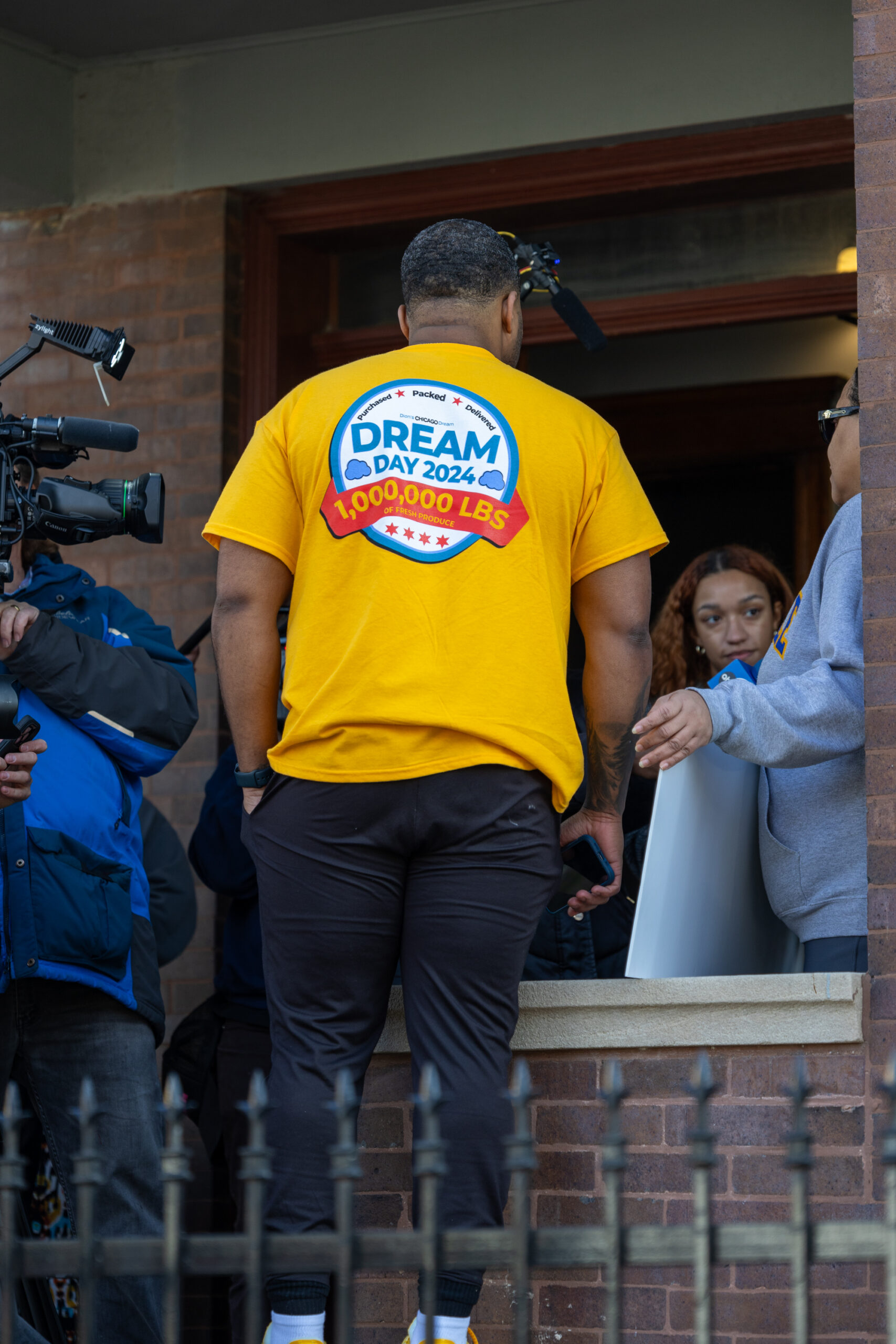
After our conversation with Dion, we visited his work in Englewood – at the Dream Fridge, and spent the morning with his team as they surprised the Thompson family with a $10,000 check from Dion’s Chicago Dream. That day, Dream Day, marked a celebration of the one millionth pound of food distributed by Dion’s Chicago Dream.
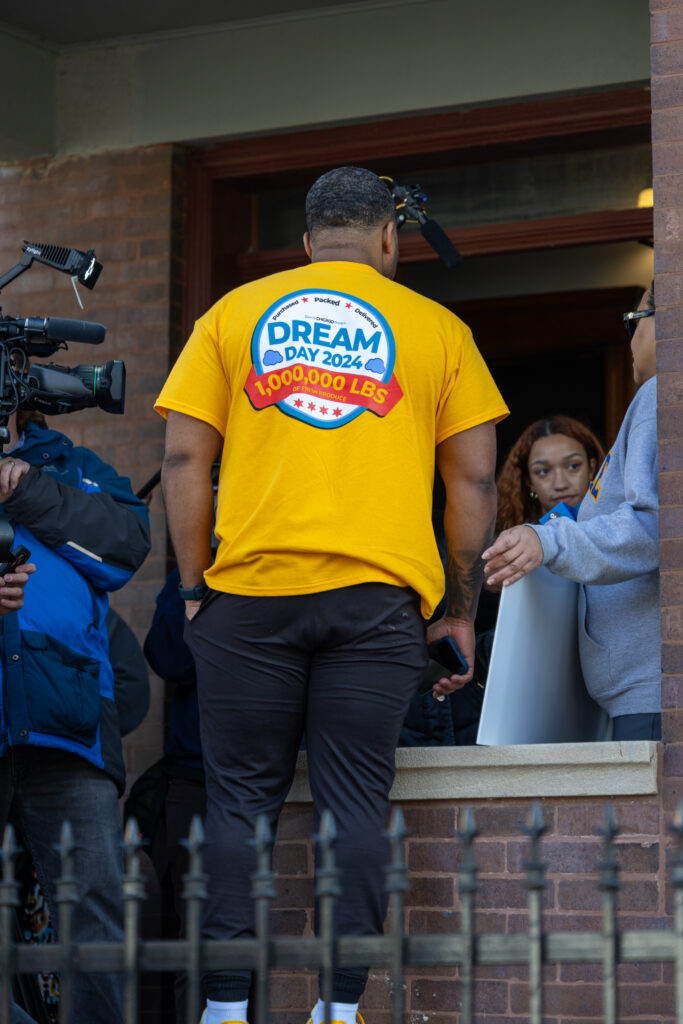
During the Dream Day celebrations, Dion reflected, “This is what I’m supposed to do in my life, I’m proud to be from Englewood, and everybody that knows me knows that. I just remember what it feels like to not have any cameras when we were doing [this], to not have the team members that we could pay, to not have the vehicles that we own and to remember what it’s about. It’s really about our residents, our recipients, everybody who has had a moment, before or after of just not knowing where that next healthy option will come from and knowing that we’re out there. Always.”
For more information on Englewood Organizations:
Englewood First Responders – englewoodfr.com
Englewood Heroes – englewoodheroes.com
Branding Englewood – brandingenglewood.org
R.A.G.E – ragenglewood.org
Imagine Englewood – imagineenglewoodif.org
Think Outside da Block – thinkoutsidedablock.org
Growing Home – growinghomeinc.org
Teamwork Englewood – teamworkenglewood.org
Something Good in Englewood – somethinggoodinenglewood.org
Mr. Dad’s Father’s Club – mrdadsfathersclub.com
Taste for the Homeless – tasteforthehomeless.org


